Shared Settings for Multiple Users
For schools, makerspaces, businesses, and other users who may need to configure multiple computers to share Devices, Settings, Material Libraries, and other configuration, we have some tools available to help you.
Licensing
To set up LightBurn licenses from the command line, see the directions for System Locked License Setup
Initial Configuration
The easiest way to configure multiple computers is with LightBurn's User Bundles, which are described further in our guide to Migrating Between Computers.
User Bundles can contain any or all of the following:
- LightBurn Settings
- Custom Hotkeys
- Material Test Presets
- Image Presets
- Devices (including cameras)
- Material Libraries
- Art Libraries
To share your settings:
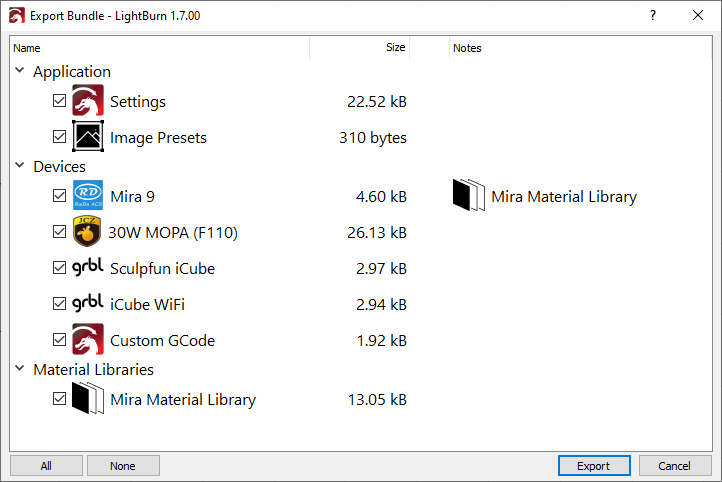
- Make LightBurn is configured the way you want on your first computer.
- Create a User Bundle by going to File → Bundles → Export Bundle.
- Save your User Bundle somewhere accessible to all the other computers you want to configure. The exact way you do this will depend on your setup, but a few possibilities:
- If you have user profiles managed by your IT department, they may be able to place the
.lbzipfile somewhere accessible (such as the desktop) for all users. - Save the file to a network drive. If you're in a school or other environment with an IT department, they may be able to help you set one up if you don't currently have one.
- Save the file to a shared folder in a cloud storage service like Google Drive, OneDrive, or Dropbox.
- Use shared folders through your operating system or a service like Syncthing.
- If you don't have any network-based sharing options, save to a USB drive or similar.
- If you have user profiles managed by your IT department, they may be able to place the
- On each other computer you want to configure, open LightBurn and load the User Bundle by doing one of the following (or have users do this):
- Go to File → Bundles → Import Bundle and select the
.lbzipfile you created. - Drag the
.lbzipfile into the LightBurn window.
- Go to File → Bundles → Import Bundle and select the
- Select the components of the bundle you want to use and click Import.
If you keep the User Bundle available for users, they can repeat the import process if they need to restore their configuration.
defaultprefs.ini
In earlier forum posts, there are references to using a defaultprefs.ini to set default Lightburn settings each time the program starts up. At the present time, this is not currently recommended as it may not work reliably.
Ongoing Updates
While you probably won't be changing your Device List very often, you may want to update Material Libraries or Art Libraries more often and share those changes with users.
Libraries are reloaded every time LightBurn starts up, so you can have each computer load a Material Library or Art Library from a shared file, and at every startup, the most recent version will be loaded.
Material Library
Material Libraries make it easy to store, look up, and apply cut settings. You can use Material Libraries to share your cut settings between computers. Once a Material Library is loaded, applying your cut settings is as easy as opening the Material Library Window, selecting the correct Material Library entry, and choosing either Apply or Link.
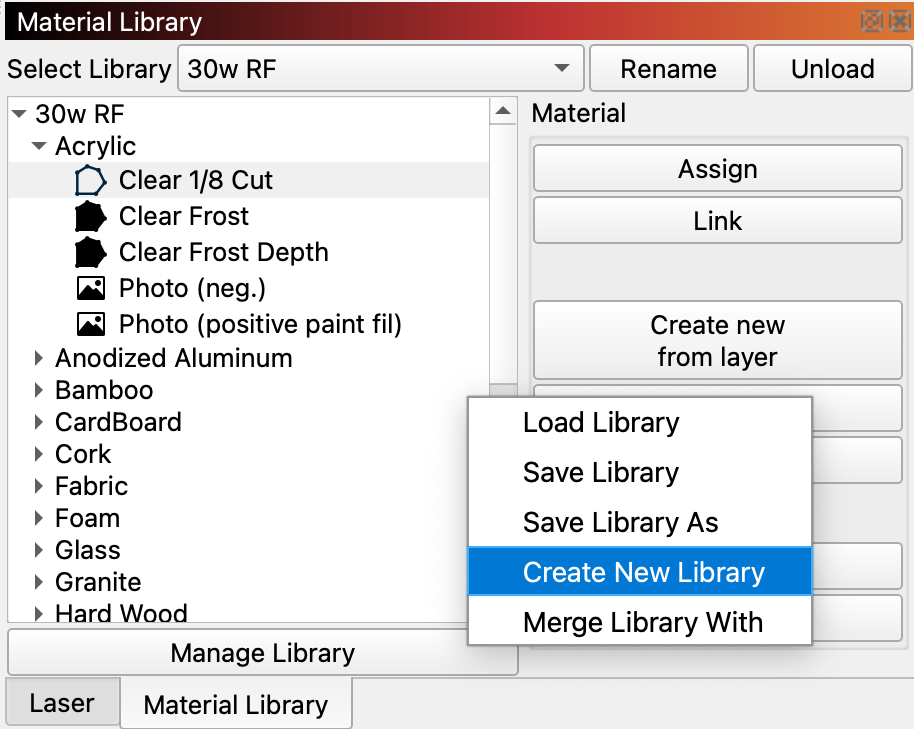
Use the Manage Library button to manage Material Libraries.
- Use Save Library As to save a copy of your active Material Library to a location of your choice. If you're sharing your Material Library with other users, this may be better than sharing your Material Library directly, in case other users change the entries unexpectedly.
- Have users on other computers use Load Library to load your shared Material Library file from a shared file.
Art Library
For art resources you want to share, consider using a shared Art Library. This can be useful for shared artwork, but also for creating placeholders representing engraving blanks you use, various cutting templates, or material sizes.
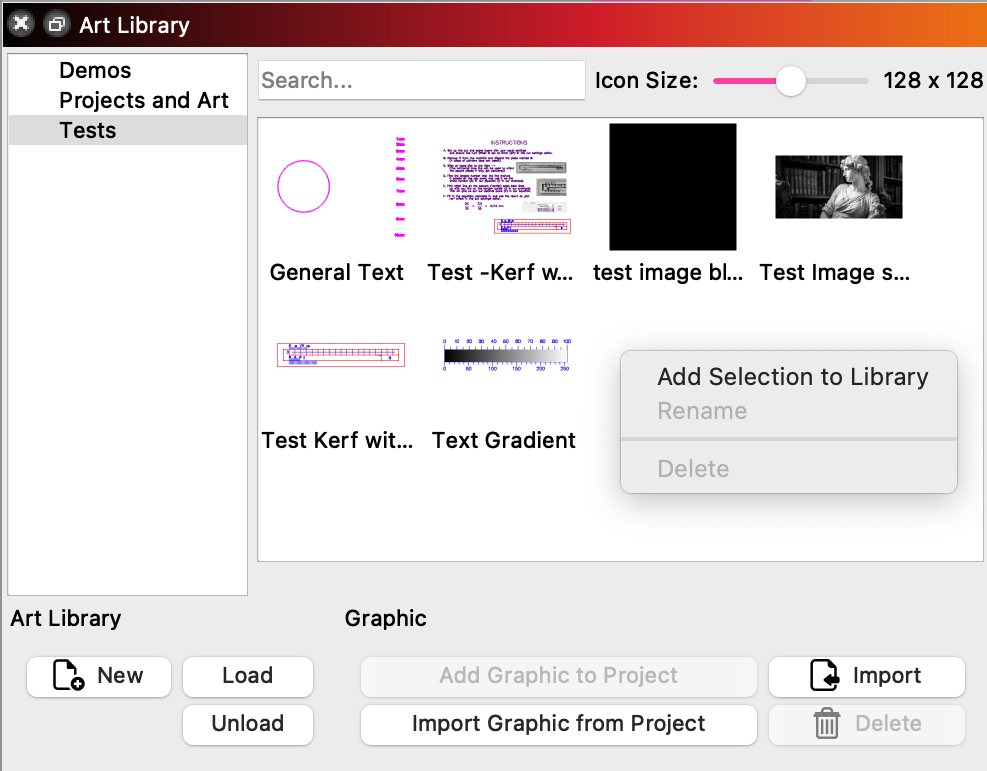
- To share an Art Library, find the
.lbartfile for the Art Library you want to share and copy it to a shared location. - Users can load an Art Library by clicking the Load button in the bottom of the Art Library window and selecting your shared
.lbartfile.