Fire Safety
Here at LightBurn, we've always asked our users to supervise their lasers whenever they're running, and discouraged the remote use of lasers. We've also reminded users to make proper preparations in case a fire does occur.
It can be tempting to leave your laser running and walk away during a long job, especially when you're busy and have other things to do. You've made sure your settings are good, you've never had a fire before, you've got a camera set up so you can watch your laser...
You still need to stay with your laser and supervise it.
Jump to Fire Safety Preparations
These two pictures are from two different incidents. In the first photo, close supervision of the laser and the quick reaction of the LightBurn staff member who was running it prevented a fire and further damage. In the second, proper preparations as well as quick reactions once the fire was noticed prevented a fire from becoming a tragedy.
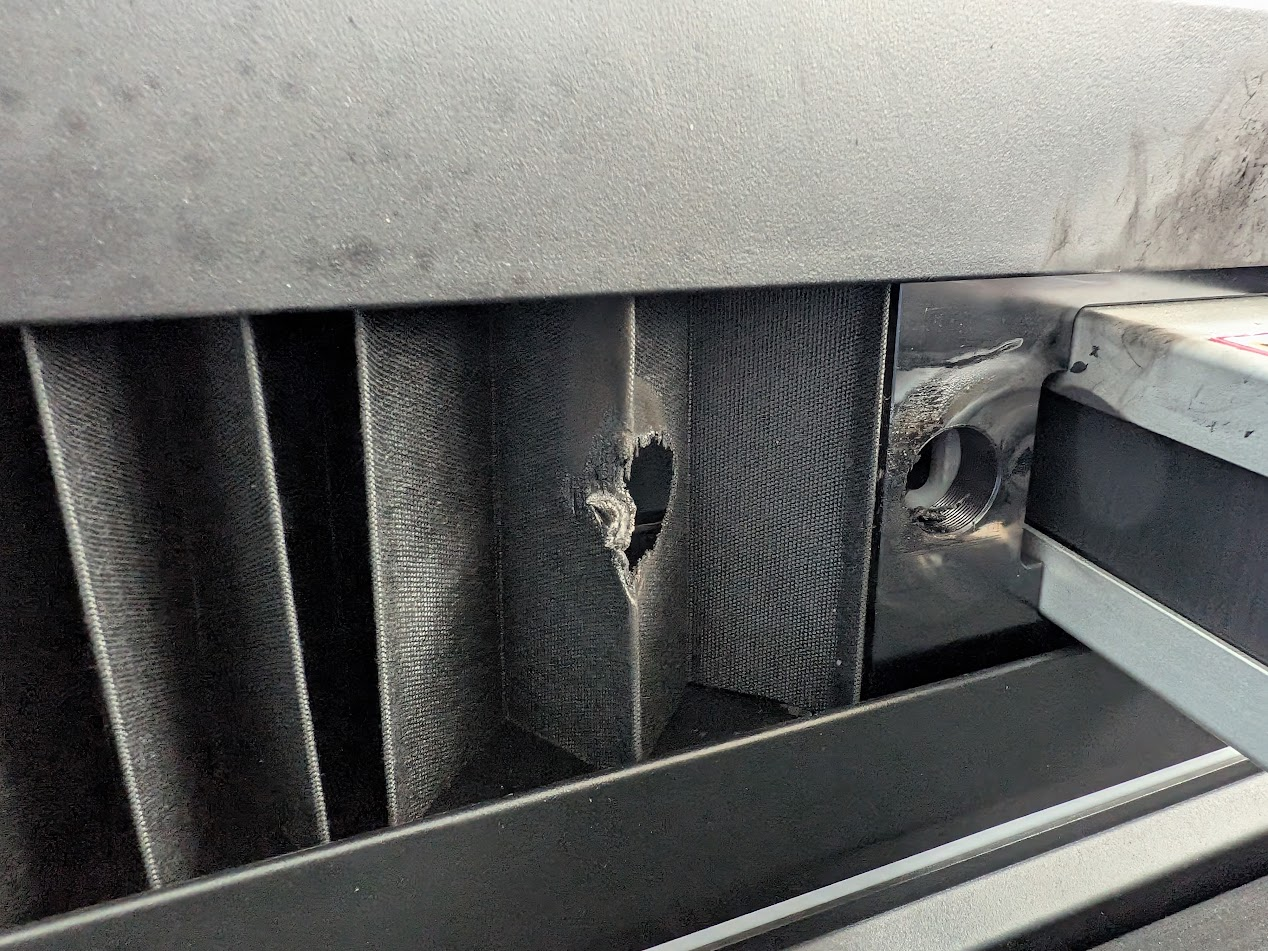
A covering inside this laser got in the way of the laser beam, but the damage was spotted immediately and the laser was stopped before anything worse could happen.
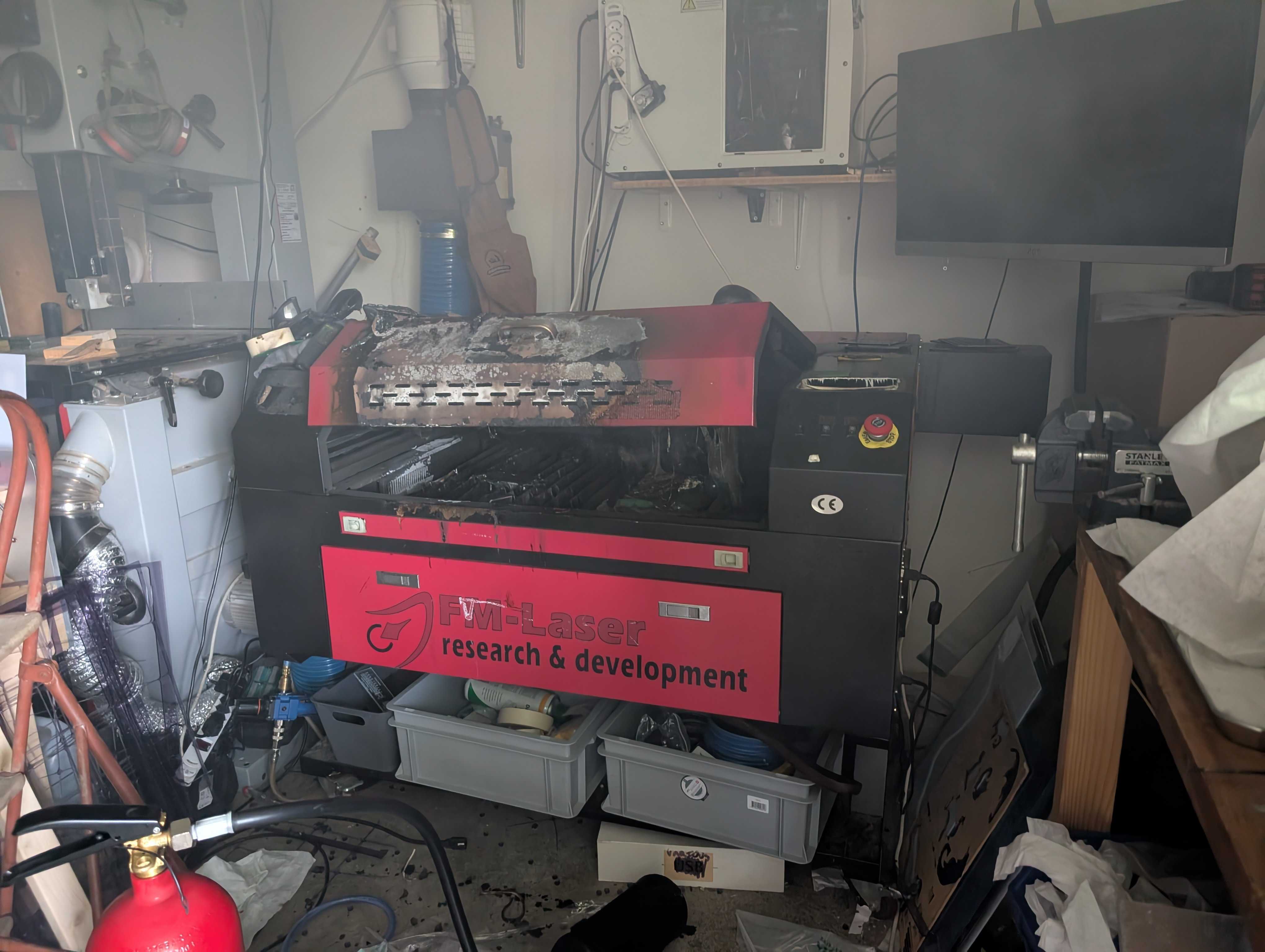
A minor flare-up happened while the laser was unsupervised. Within a few minutes, this was the result.
Whenever you laser, you're deliberately burning away material, and that also creates smoke full of flammable particulates. Fires can happen unexpectedly and grow shockingly quickly. Right when they start, they can usually be put out without serious damage, but only if you're prepared and can act right away. Stopping the laser from firing and either moving the head away or turning off the air assist is a good start, and may even be enough on its own. By stopping the laser and the air assist, you're not putting more energy into a growing fire or blowing oxygen-rich air right into it. If that's not enough to stop the fire and it's still small, a spray bottle of water may be enough.
If smaller interventions aren't working, or if you didn't respond quite as quickly, you're going to need to take more serious action.
In case a fire happens, you should always have the following easily accessible near your laser, placed so you can reach them without reaching over or around the machine:
- A spray bottle of water. For small flare-ups on the material you're cutting, this may be adequate.
- A suitable fire extinguisher. We use CO2 fire extinguishers, which don't damage the laser, reducing reluctance to use them. Read more here.
- A fire blanket.
Check the manufacturer's information on how to use the fire extinguisher and fire blanket before you need them, and don't hesitate to use any of these if there's even a chance the situation calls for it.
The Laser Fire
The burnt laser above belongs to one of our staff here at LightBurn. He had a camera set up to watch the laser while it ran a job. He's typically very cautious, but relaxed a bit this time and let it run in the background. It only took a few minutes to go from the first hints of sustained flame to what you'll see in these pictures he's shared.
This GIF is sped up, but shows the material catching fire, which then spreads through the machine and into the crumb tray below the bed. In reality, this was about 4 minutes. At the start, when there were just a few small flames, this would have been easy to put out.
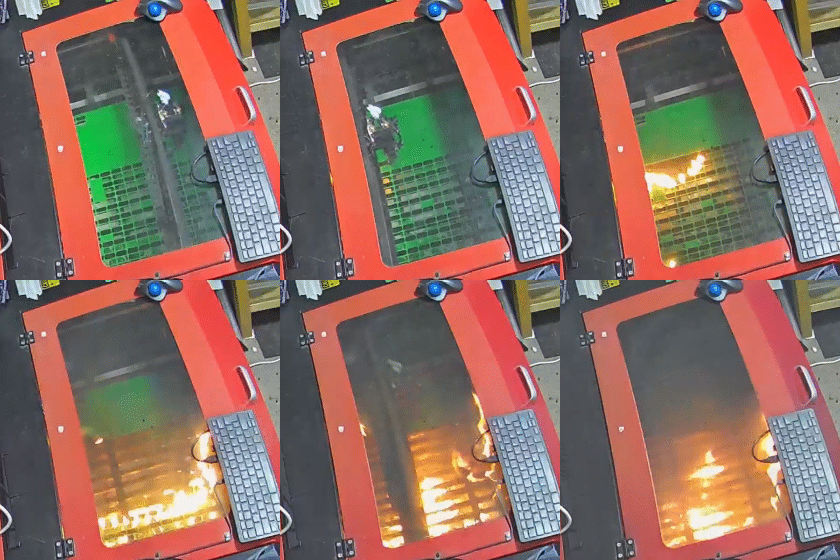
This laser had a metal frame, which helped contain the fire and protect the surroundings. For an open-frame or primarily plastic laser, the fire likely would have gotten out of control faster, with more damage. By the time our staff member got to the laser to put it out, the workshop was full of smoke. Fortunately, he was well-prepared with an easily accessible fire extinguisher, and was able to put out the fire before it spread further. Even so, the heat from the fire destroyed the chiller on the shelf above the laser in addition to the laser itself.
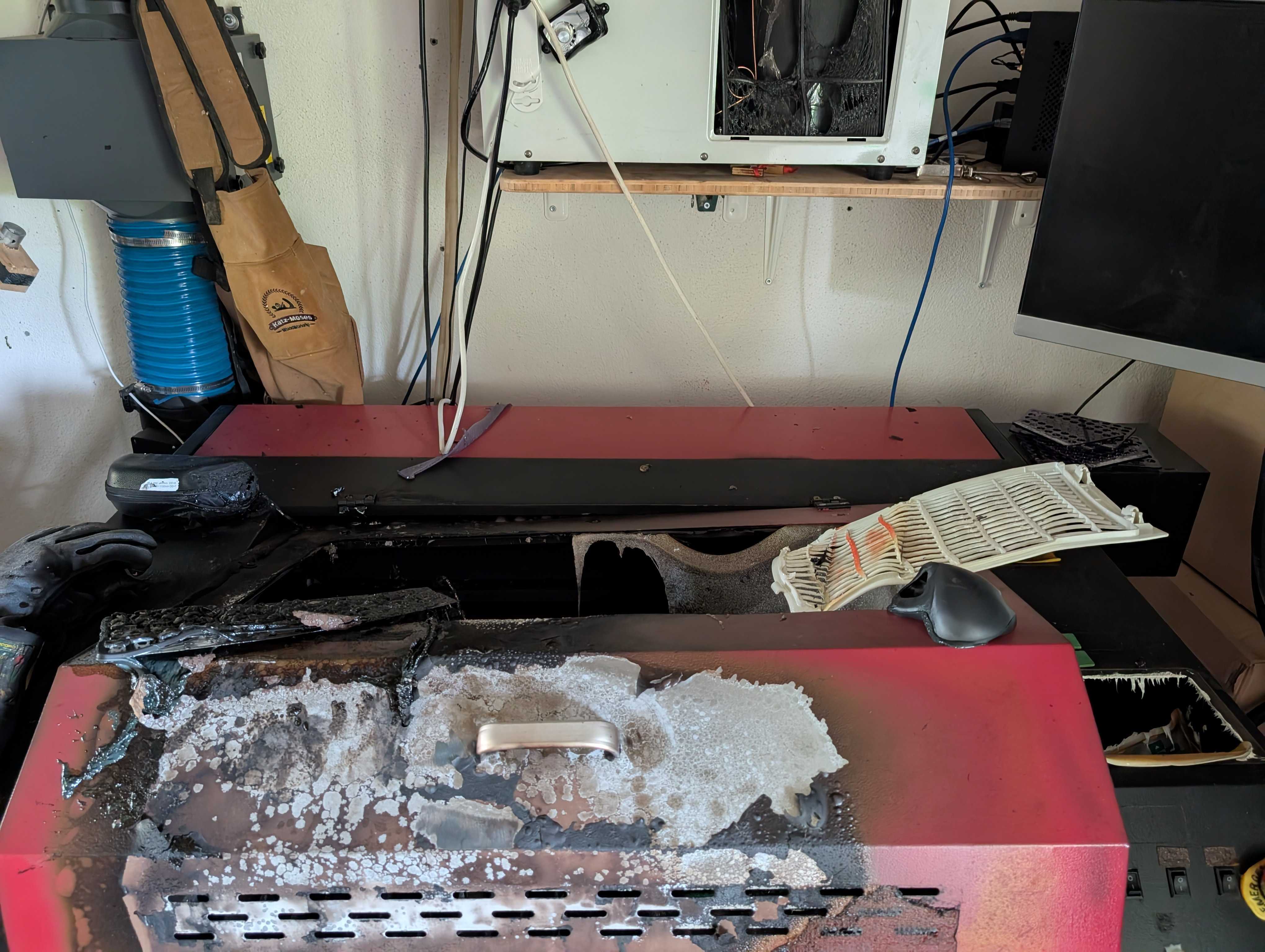
After the fire was extinguished.
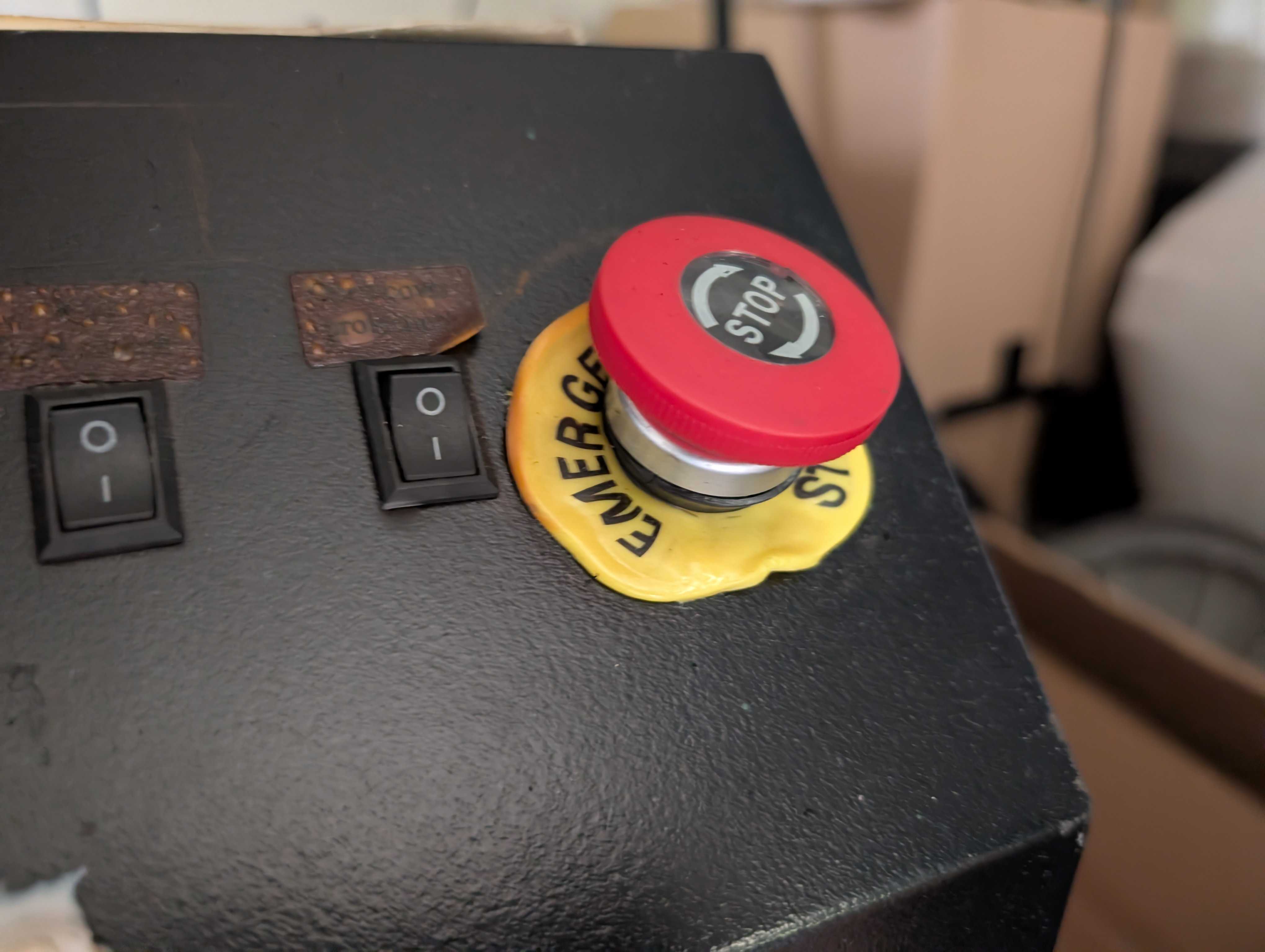
An emergency stop button like this is an important safety feature for being able to cut power to the laser immediately in an emergency situation.
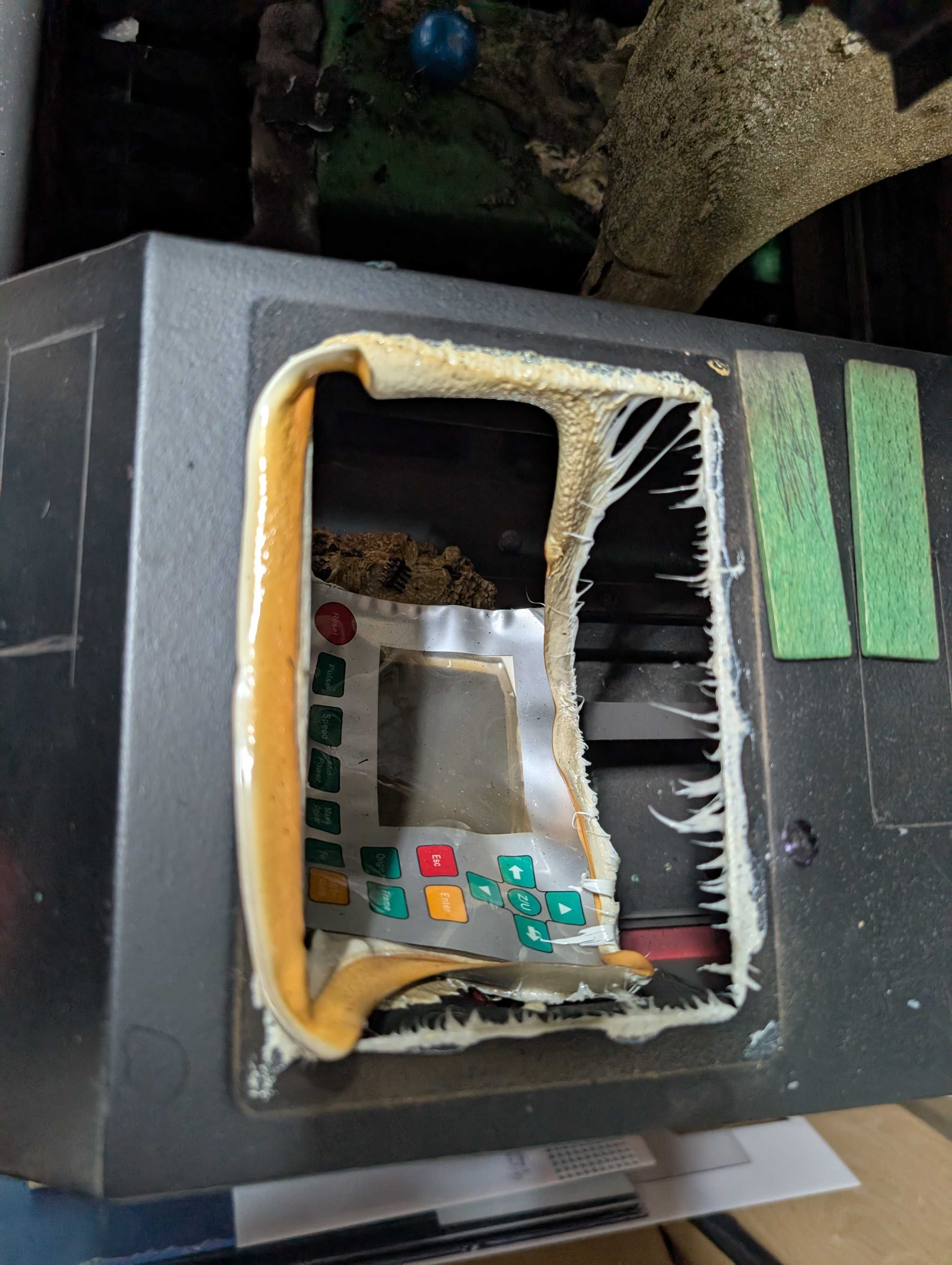
The panel holding the machine's Ruida control panel melted and dropped down into the body of the laser cutter.
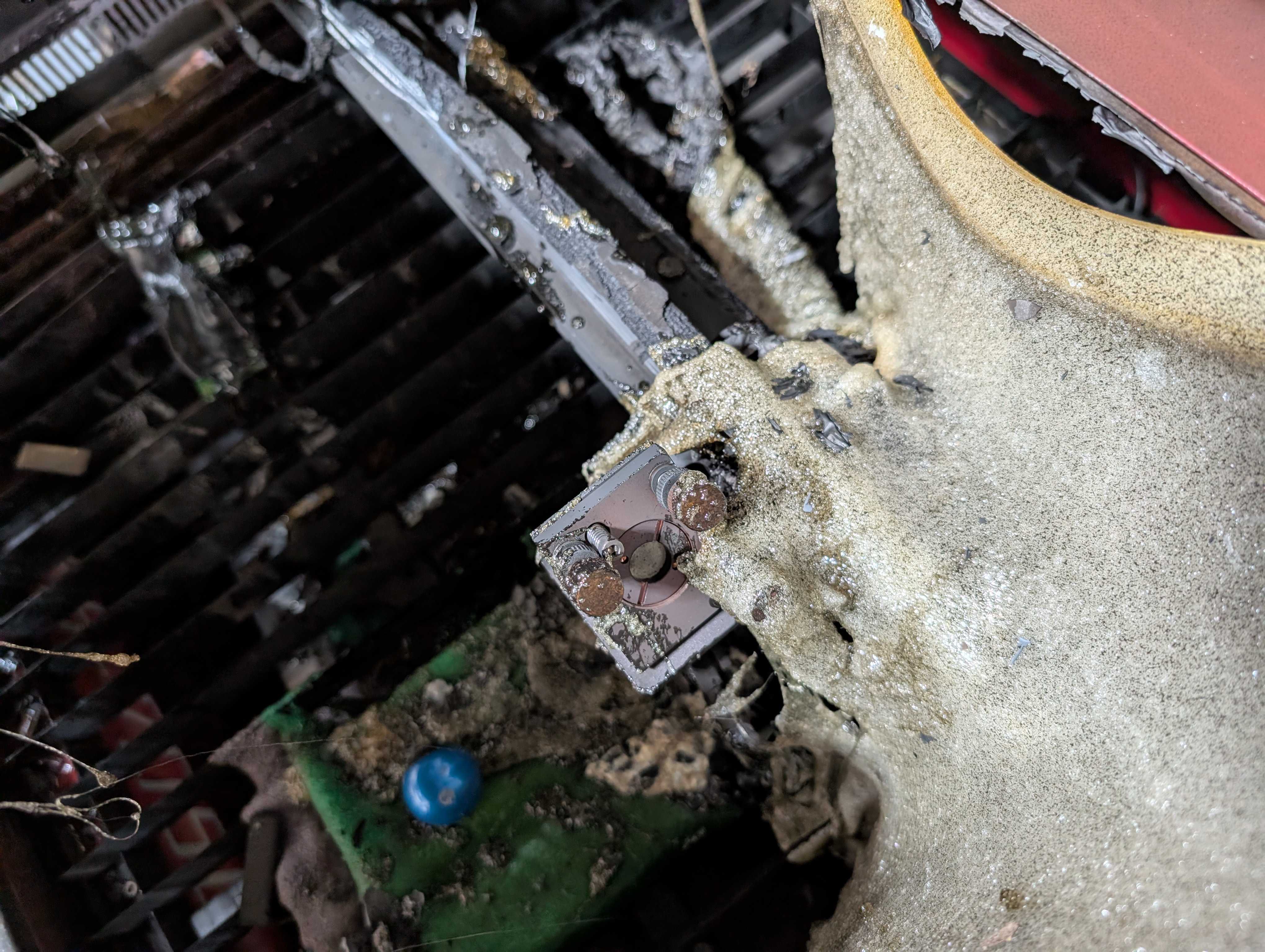
More damage inside the laser.
Fire Safety Preparations
- Never run your laser unsupervised. A camera feed does not count as supervision.
- Have a smoke detector near the laser cutter.
- Have a suitable fire extinguisher, fire blanket, and spray bottle of water near the laser. Make sure you'll be able to reach them if there is a fire. Ensure that you and everybody who might use your laser knows how to use these tools to put out a fire.
- Know how to shut off your laser quickly in an emergency.
- Make sure that anybody who might operate or be asked to supervise your laser knows what to do in the event of a fire.
- Avoid having easily flammable objects near the laser.
- Keep the interior of your laser clean. Small bits of material in the crumb tray under the laser bed can act like kindling and worsen a fire.
- Be aware of the materials you're using. Materials with air pockets (like corrugated cardboard or some plywood) are more prone to catching fire.
- Refer to your manufacturer's recommendations for proper machine operation, including how to reduce the chances for accidents and prevent fires.
- Do not rely on hardware-based fire detection or fire suppression accessories — they're not an adequate substitute for your attention and preparedness.
What to Do If A Fire Happens
- Stop firing the laser and turn off the air assist. Most devices will have a way to pause or stop the job right from the machine. If you catch the fire fast enough that it's still just a small flare up, this may be enough to extinguish the fire.
- If the fire isn't going out but is still small, a spray bottle of water may be enough to put it out. Keep this near your laser just in case.
- If the fire still isn't going out, or if you didn't catch it early enough and it's more than a small flame, it's time for a fire blanket and/or fire extinguisher. Make sure you know how to use these before a fire happens. There won't be enough time to figure it out when you need it. After the fire is extinguished, make sure that if any material is still smoldering, you fully extinguish it with water.
- If you've still got a fire, call your fire department.
- After the fire is out, ventilate the room to bring in fresh air and avoid breathing in smoke for longer than you need to. This is especially important if you've used a CO2 extinguisher, which displaces oxygen to put out the fire.
Fire Extinguishers
Please make sure you check your local standards for fire extinguishers.
Read more about fire extinguishers from:
Fire extinguishers are rated according to capacity and the types of fires they can be used with, and many are multi-purpose, suitable for multiple types of fires. For a laser cutter, make sure your fire extinguisher includes a Class C rating, meaning it uses a non-conductive extinguishing agent and can be used on appliances that are plugged into an outlet.
There are several types of fire extinguishers, but the most relevant for a laser cutter are CO2 and Dry Chemical extinguishers.
CO2 extinguishers smother a fire by replacing oxygen with CO2 gas.
- They are generally preferred for use with laser cutters and other electronics, because they don't damage the laser.
- They pose a risk of asphyxiation in small, poorly ventilated rooms. It's important to air out the room well after use to bring in breathable air.
- They are somewhat less effective than Dry Chemical extinguishers on combustible materials, but because they don't damage equipment, users are likely to use them earlier, while a fire is still small.
Dry Chemical extinguishers are multipurpose extinguishers, which use monoammonium phosphate powder to extinguish a fire.
- They are suitable for electrical fires and also highly effective on combustible materials.
- They do not pose a risk of asphyxiation, but contacting or breathing in the powder can cause throat and skin irritation.
- The powder used is corrosive, and will destroy your laser.